


A strong E-2 business plan explains what the company will sell, how it will enter the U.S. market, and what supports its expenses, investment, and projections. Start with the seven sections below. They will help you connect market data, cost estimates, the financial model, and supporting documents so that the basis for each key assumption is clear.
Throughout all seven sections, we will use a hypothetical product photography studio in Phoenix as an example. It photographs products for small online stores. The locations, amounts, and scenarios in the example are used to demonstrate the method. They do not reflect market prices or establish an investment threshold for E-2. The U.S. Department of State describes the category’s general requirements and the consular application process.
Business Model and the Investor’s Role
On the first page, explain what need the U.S. company meets and what work it gets paid to do. For the studio, this might be a catalog shoot with an agreed-upon number of edited photographs. Identify the customer type, service area, and deliverable format. A customer will understand “photographing ten products and delivering files for an online store” more readily than “creative solutions for small businesses.” This level of detail will also be useful in the financial section. It provides a basis for estimating how long an order will take, the cost of materials, and the team’s workload.
Show how the company will handle an order from the initial inquiry through payment. Who confirms the scope, receives the products, gets approval for test shots, and takes responsibility for deadlines? Who makes sure the samples are returned to the client? In a small studio, the founder handles some steps and a photo retoucher handles others. As the number of orders grows, responsibilities need to be reassigned. This operational structure will form the basis of the hiring plan.
For E-2, it is also important to show how the investor will develop and direct the enterprise. Specify the investor’s authority in the business plan. For example, the investor approves pricing, signs key contracts, controls the budget, and makes hiring decisions. Cross-check this description against the company documents, especially if authority to sign contracts or make decisions is shared among several owners. For a general overview of the category and its applicability to different business models, see the “E-1 and E-2 Visas” section.
When purchasing an existing company, start by explaining what transfers to the buyer with the business. Specify which assets are included, what will happen to the lease, and what role the previous owner will have after the transaction.
For a new business, the steps are different: securing premises and equipment, setting up processes, and fulfilling the first paid order. State what has already been done, what has been agreed upon, and what is planned. The reader should be able to see where the project’s current status ends and the first-year plan begins.
It is helpful to write the executive summary last, once pricing, expenses, and timelines have been pulled together. Simply explain how the company earns revenue, what the investor does, how much the launch will cost according to the budget, and what operational milestone the project has already reached. If the summary promises a spring launch, the lease, installation, and equipment readiness dates must align in the schedule. It is better to catch inconsistencies on the first page before it is copied into multiple files.
Add a few prerequisites for getting started to the schedule. For example, it makes sense to confirm the date of the first shoot only after you know when you will have access to the space and whether it can be used for the planned work. When buying a studio, the equivalent question is different: will the new owner be able to fulfill existing orders during the transition? These prerequisites explain the timeline better than a list of appealing dates.
Market, Customers, and Initial Sales
Define the market at the level where the business can realistically make sales. For a studio in Phoenix, it is more useful to understand which local stores already commission photography and how often they update their product listings than to describe the size of the entire U.S. e-commerce market. Also specify the service area. A small product can be sent by courier, while photographing a large item may require an on-site visit. These jobs have different costs and turnaround times.
Gather several comparable offerings from competitors. Compare packages with the same scope: number of products, number of images, turnaround time, retouching, and surcharges for materials that are difficult to photograph. Record the date and source of each price. If a price list is published without details, say so. You can estimate the cost of additional work based on your own test order and label that estimate as an assumption. Interviews with store owners are also useful here. Ask about past orders and specific problems rather than their general willingness to buy the service someday.
Once you have a price, show the sales channel. For example, the studio contacts stores, receives a brief, prepares an estimate, and then converts some inquiries into orders. A letter of interest confirms contact. A paid order confirms a transaction. These events carry different weight in a sales forecast. If there are no orders yet, make that clear and describe how you will test the initial demand estimate with a limited sample of customers.
If stores are choosing between taking photos themselves, hiring a freelancer, and using a studio, explain the value of the package. One customer pays for consistent images across a large product line; another pays for quick turnaround on additional photos. Both needs affect pricing and how you attract customers. As you prepare the offering for launch, these questions can be explored separately as part of brand positioning.
In the sales table, it is useful to separate new and repeat orders. If the average customer returns once a quarter, that customer cannot be counted as a source of monthly revenue.
Specify what counts as a repeat order, and exclude discussions that have not resulted in an agreed scope of work from the calculations. If the market overview uses last year's data, note which information you have checked recently. This keeps the E-2 business plan verifiable even after the initial business metrics change.
Write down in advance what would prompt you to revise your pricing or range of services. If customers value speed but are only occasionally willing to pay a rush fee, the plan for rush orders should reflect that. The same applies to promises of repeat orders. A single note from a conversation may suggest a hypothesis. An agreed scope of work, a repeat inquiry, and payment gradually provide a basis for replacing that hypothesis with fact.
Investment and Cash Flow
The startup budget answers the question of how much it actually costs to establish or acquire an operating business. The payment register shows what has already been paid, which expenses are covered by signed commitments, and which amounts are still only budgeted. It is useful to include both tables in the E-2 business plan. The first shows the scale of the project. The second lets readers check the status of each payment and locate supporting documents.
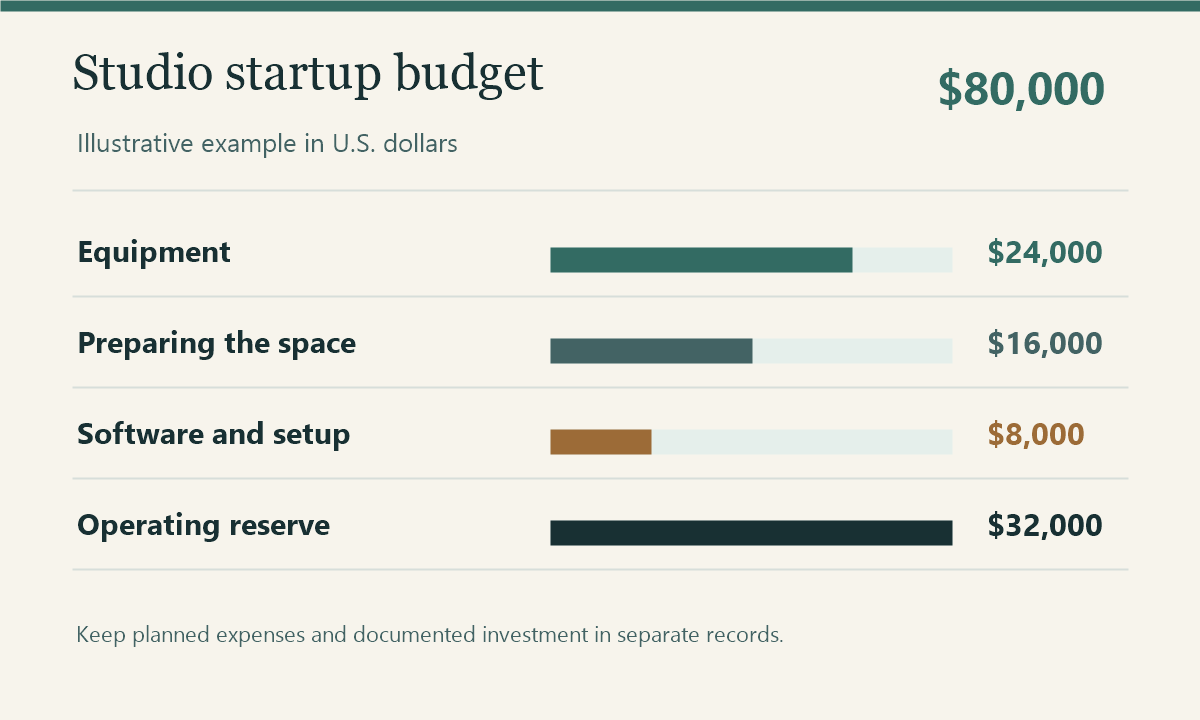
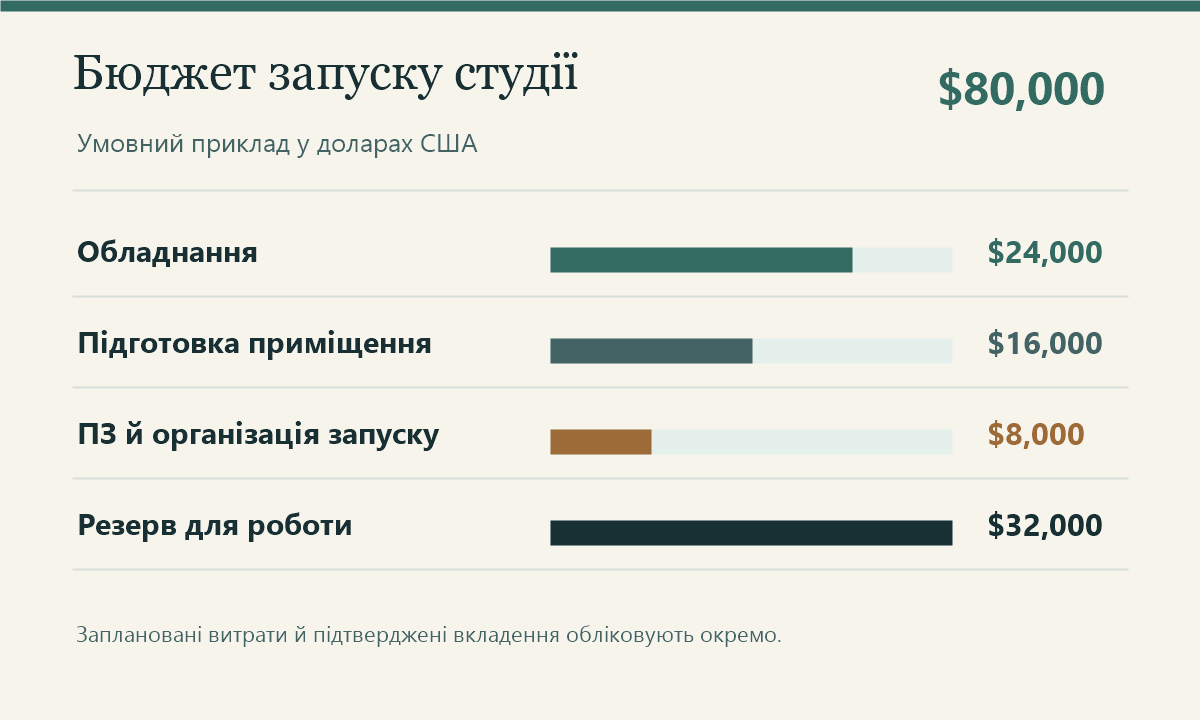
A hypothetical studio has a budget of $80 000. The cost estimate allocates $24 000 to equipment, $16 000 to preparing the space, $8 000 to software and administrative expenses, and $32 000 to a reserve for ongoing operations. Suppose the studio has already purchased the equipment. The invoice and proof of actual payment would then be attached to the $24 000 line item. The payment field for future renovations can be left blank, with the agreed-upon cost estimate or documentation of the commitment listed separately.

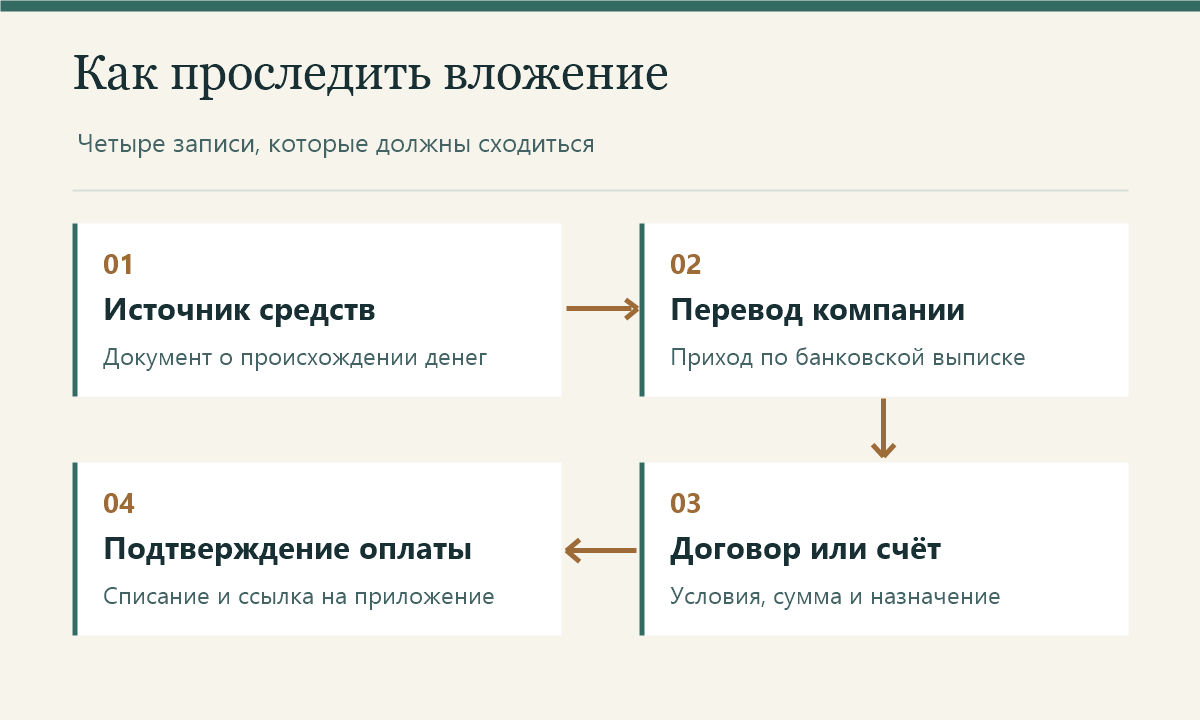
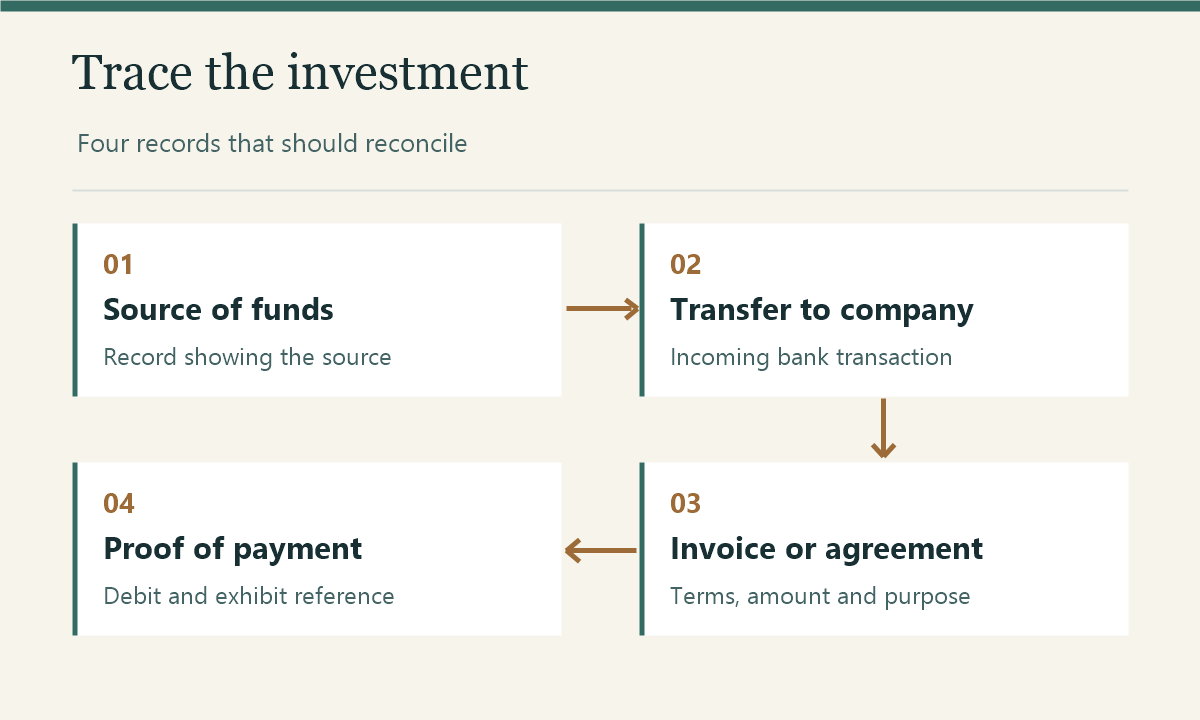
Trace the movement of funds for every amount you include in the list of actual investments. In this hypothetical example, the first folder contains documentation of the source of funds; the second, a statement showing the deposit into the business account; the third, a contract or invoice from the seller; and the fourth, proof that the payment cleared. A single payment may cover several items, and a contractor may issue two invoices for the same job. The register should allow you to calculate the total without double counting.
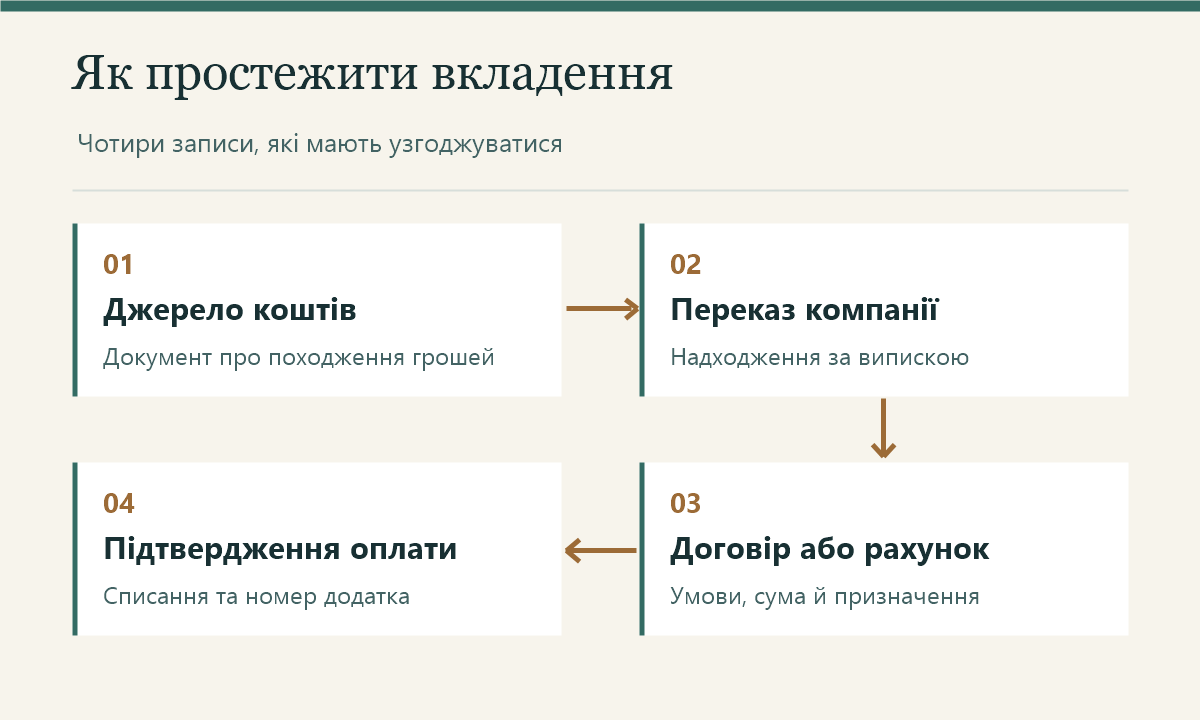
The consular guidance considers whether an investment is substantial in relation to the cost of purchasing or establishing the business and the investor’s financial commitment. It does not set a universal minimum dollar threshold. The source, ownership, and control of the funds, the nature of the risk, and the extent to which the funds are committed to the business all matter. A bank statement shows the available account balance. Documenting an investment requires records of expenditures or obligations incurred. Questionable payments and transaction terms are best reviewed separately with a licensed attorney. Department of State consular guidance, 9 FAM 402.9.
For payments in multiple currencies, specify the original amount, currency, date, and conversion method. When calculating the budget, clarify which figures include taxes, shipping, and installation. If an invoice amount changes, keep the latest quote and a note identifying what it replaced. Then check that the same total appears in the project overview, financial file, and attachments describing the transaction.
If you are buying an existing business, separate the purchase price from post-transfer expenses. The transaction valuation may include equipment, inventory, and contractual rights being transferred.
In the post-closing budget, allow for items such as equipment maintenance, migration to new systems, or replenishing working capital. Note separately which contract terms you have verified and which remain under negotiation. Whether customers and recurring orders transfer along with the assets makes a significant difference to the forecast.
Operating Expenses and Reserves
After preparing the startup cost estimate, create an operating budget. First, list the studio’s recurring expenses: rent, insurance, software subscriptions, and pay for the regular team. Then identify the costs associated with each order: retouching, consumables, and delivery. This breakdown will help you understand where the company can cut costs when sales are weak and which payments will remain due even in a month with no clients.
A payment under a contract often falls in a particular month, while the corresponding accounting entry follows a different recognition basis. If equipment is paid for before opening, the cash impact is immediate. If clients pay after 30 days, materials and labor may be needed before payment arrives. Prepare a schedule of cash receipts and payments separately from the profit and loss statement. Otherwise, you could show a positive margin and still be short of cash for the next rent payment.
The reserve in this example is 32 000 dollars. Support that amount with a month-by-month cash flow plan. Show how much cash will be needed before the first customer payments arrive and what will change if sales ramp up more slowly. Specify how much of the reserve is already earmarked for particular payments and how much remains for contingencies. For a new business, this matters more than a single total with no explanation. If the business is already operating, compare the calculation with actual cash flow, seasonal patterns, and overdue payments.
Each major expense estimate should have a supporting source. For rent, use a proposal or lease; for insurance, request a quote from an insurer. Estimate the time needed to complete an order based on a trial photo shoot. Spending on an advertising test can be capped at an agreed budget, with an explanation of which results would trigger a revision. This approach helps distinguish actual prices from assumptions and makes it easier to update the model as the terms of an agreement become clearer.
The cost estimate should be dated. Record which version was used in the forecast and when you updated the rates. If the studio moves to a different space, that may affect renovation costs, rent, insurance, and the opening timeline all at once. Review both cost categories after a single change. This will help keep the E-2 business plan consistent when you review it again before submission.
For expenses with uncertain payment dates, it is useful to keep two lines in the model. Record the baseline payment date, then separately indicate when the money will be needed if the launch is delayed. This helps you anticipate, for example, that rent may already be due before customer payments start coming in. A lost month in this type of business changes the cash balance even if the annual sales plan remains unchanged.
Revenue and Financial Forecast
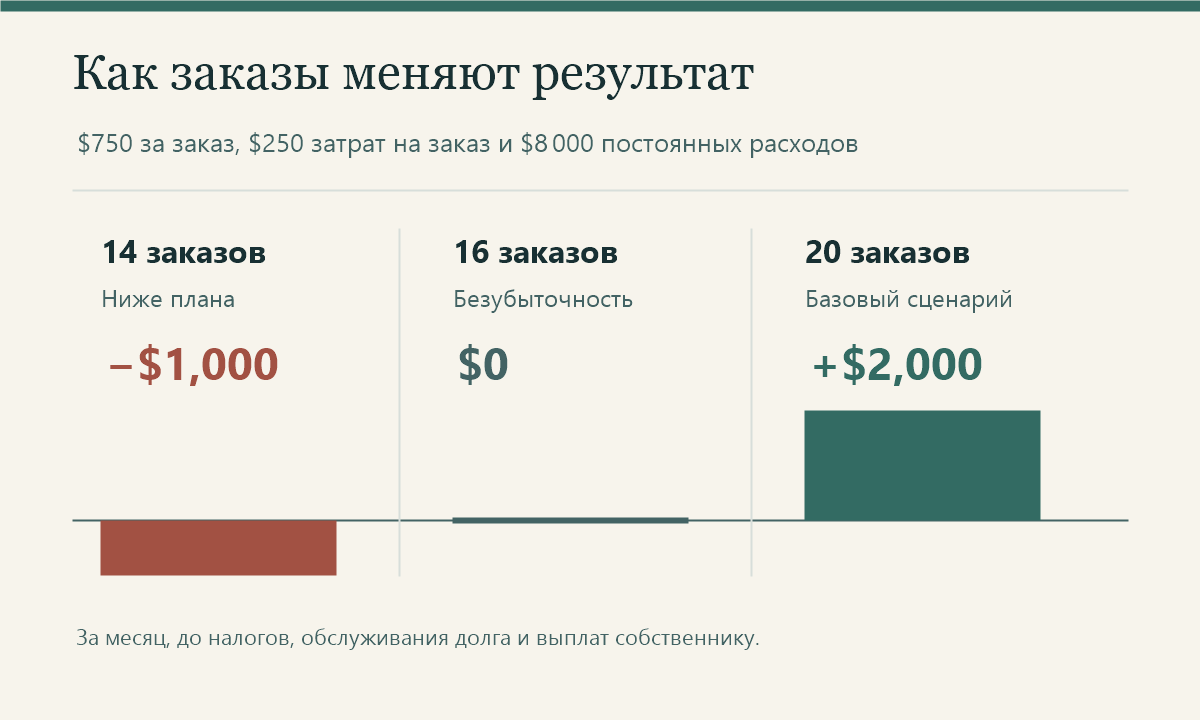
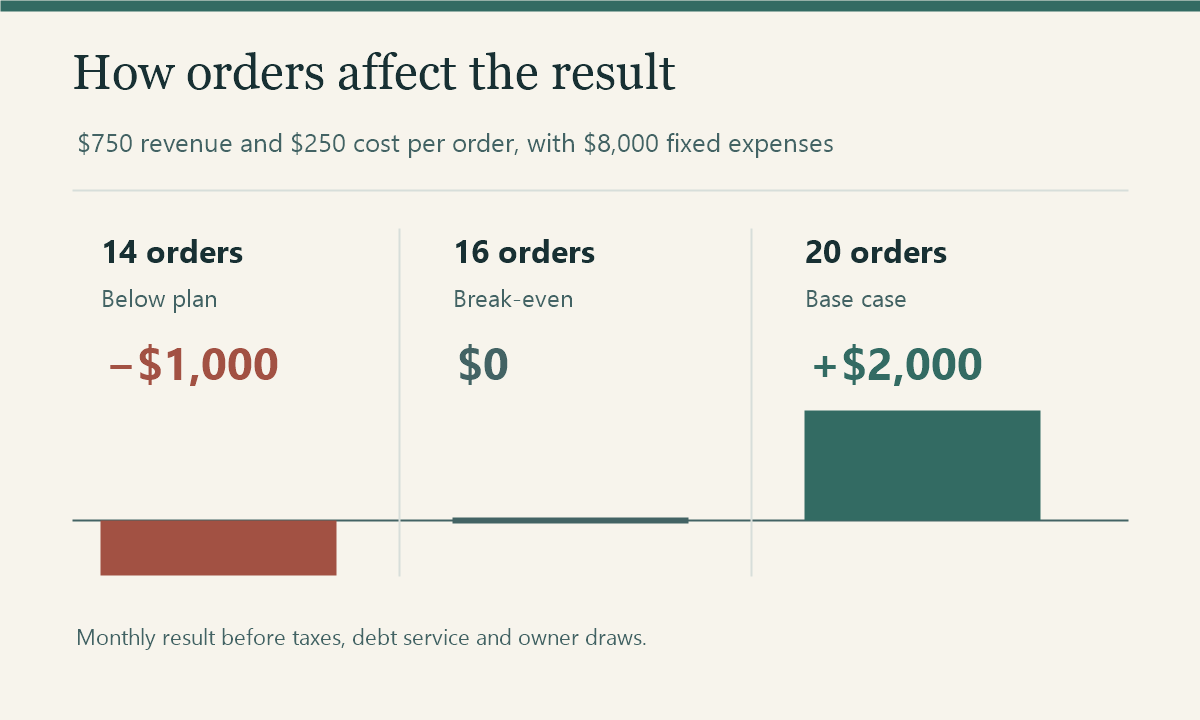
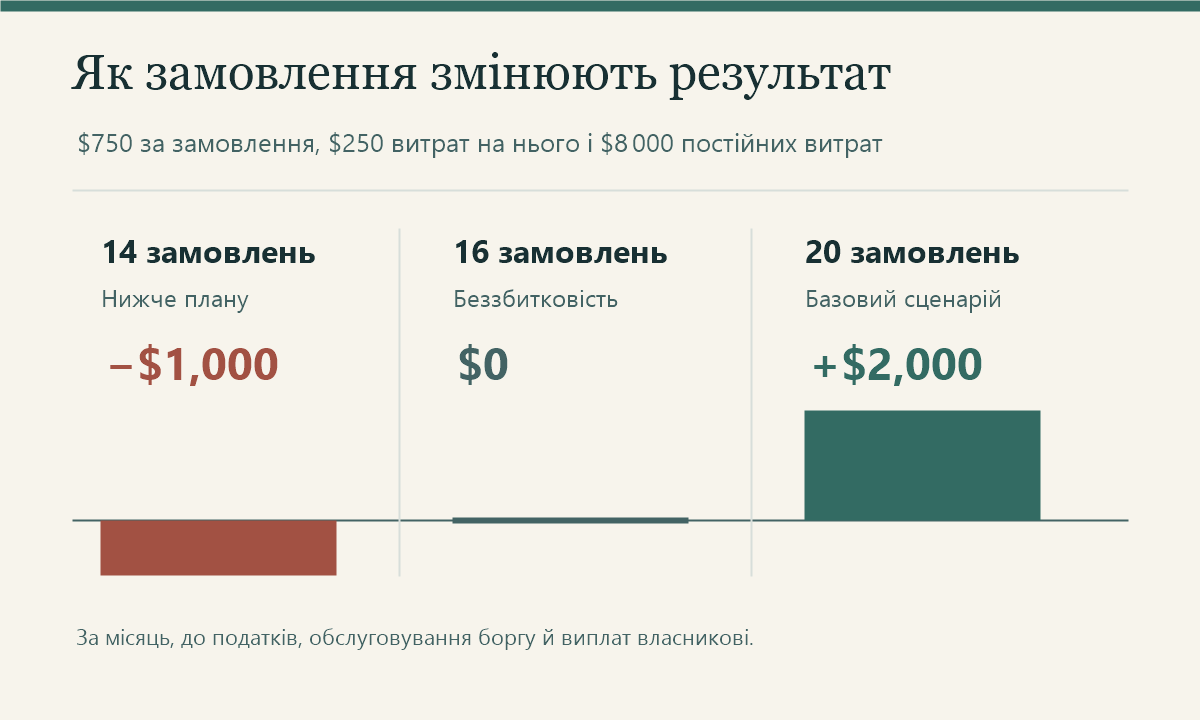
Begin the financial model by explaining the calculation. At the hypothetical studio, the average order brings in 750 dollars. Fulfilling it costs 250 dollars, and fixed expenses total 8 000 dollars per month. With 20 orders, revenue would be 15 000 dollars. After subtracting variable and fixed expenses, 2 000 dollars would remain before taxes, debt service, if any, and payments to the owner. This is a simplified calculation suitable for checking the math. In an actual model, some costs are allocated differently.


Test two more scenarios. With 16 orders at the same prices, the contribution margin covers fixed expenses. This is the operating break-even point in this example. With 14 orders, the monthly result would be a loss of 1 000 dollars before those same separate payments. This scenario shows how much reserve funding would be needed and what steps could be taken until order volume increases. If market data supports it, test how raising the package price would affect the result with the same number of orders.
For a new venture, a monthly forecast for the first year and annual forecasts for the remaining projection period are useful. For longer-term projections, explain what changes as the business grows. If sales double in the third year, compare that volume with the number of work shifts, available equipment, and retouching time. If you factor in seasonality, show what supports that assumption. In each scenario, check whether cash is available to make payments when they are due, even if the average annual result looks stable.
The consular guidance separately addresses whether the business can generate more than the minimum income needed to support the investor and their family or make a significant economic contribution. The guidance states that this projected future capacity should generally be achievable within five years after normal business operations begin.
This is a benchmark for evaluation, not a promise of a payback period, visa approval, or a fixed number of jobs. Compare the forecast with the business’s actual capabilities, and do not rely on impressive bottom-line figures without an explanation.
Save the spreadsheet along with its supporting materials. To test it, change one variable, such as customer payment terms, and see how the model responds with everything else held constant. If the model shows the same account balance, the cash flow forecast is not yet linked to operating conditions. A E-2 business plan is easier to discuss when you can explain its sensitivity to two or three key factors.
For an operating studio, start the forecast with its actual workload. If records show that it completed an average of twelve orders, explain how much growth could come from added capacity, repeat customers, or a price change. For a startup with no operating history, use verifiable assumptions: the number of working days, how many orders can realistically be completed per shift, and how long it will take to build a regular customer base. Do not add together growth from multiple channels if they reach the same customers.
Hiring Plan and Operational Workload
A hiring plan starts with the tasks the business will need someone to handle. In a studio, these include photography, image editing, order coordination, and delivery. Specify who will handle them at the outset and who will be needed as the business grows. For the first employee, describe the workload, expected start date, and costs associated with the position. Tie that date to a clear indicator, such as a steady order volume or the need to meet agreed deadlines.
Include related costs in the financial forecast, including compensation, taxes, and mandatory contributions where applicable. Working with a contractor differs from employing a staff member, including in how costs are recorded. Specify which arrangement the budget assumes, and confirm the applicable rules with a qualified specialist. If contractor support is included in variable costs per order, do not count the same work again in the fixed-cost budget.
If the business is already operating, list its employees and their responsibilities. Specify which documents can substantiate this information. For a startup, identify which positions are only planned. A studio’s first position may be needed when the volume of photo shoots begins to crowd out time for client communication. Another employee may be needed when the studio can no longer keep up with image editing within its usual turnaround times. The plan should explain how investment and operating decisions support the company’s operations in the United States.
Specify the scenario in which hiring would be postponed. If demand falls below the forecast, the studio may temporarily divide tasks between the founder and existing contractors under permissible arrangements. Show how this decision affects turnaround times and cash reserves. This demonstrates that the forecast accounts for more than just a favorable scenario. Team size alone is no substitute for analyzing how the business earns revenue and what it produces.
When an owner needs a separate presentation for prospective partners, verified calculations from the business plan can be used to create a shorter document with a partnership proposal. For this purpose, the team offers a presentation and pitch deck development service.
How to Verify an E-2 Business Plan Against Supporting Documents
Add a reference to a supporting exhibit for each material statement. Document the owner's role with corporate records. For premises expenses, include the lease and cost estimates. Use invoices and payment records to substantiate equipment purchases. For an operating business, records of actual operations, such as client contracts and financial statements, if available, will be useful. For a startup, separate documents showing readiness to operate from those that already substantiate sales or completed payments.

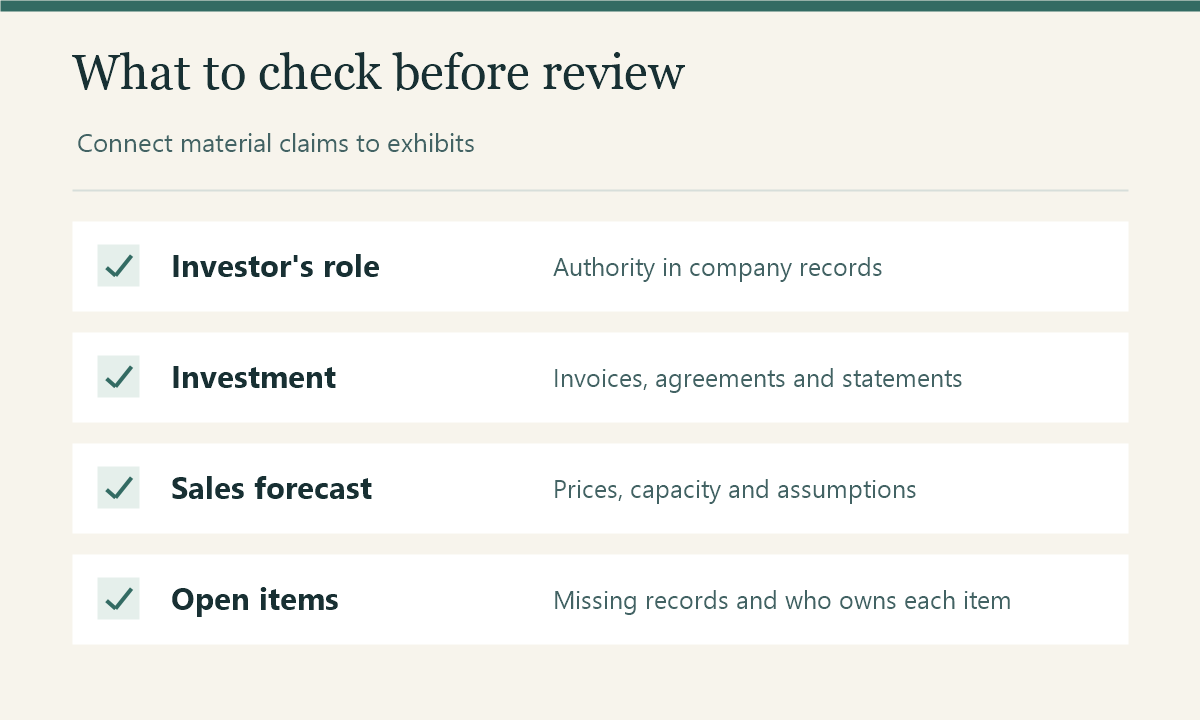

Create an index that includes the statement, file name, document date, and a status note. For example: “lighting and backdrop paid for,” “lease under review,” or “first-month revenue is projected.” Insert exhibit numbers in the text. Before handing over the folder, open a few files from different sections and verify that each exhibit number points to the correct contract, statement entry, or invoice.
Cross-check the company's legal name, the premises address, the ownership structure, payment status, and the forecast date. Discrepancies often arise after a well-intentioned edit to a single file.
If the budget changes, update the executive summary, investment table, and forecast notes. Reproduce names and amounts from the documents accurately. Keep working versions containing personal and banking information separate from the copy used for collaborative editing.
Check the instructions for the specific embassy or consulate where you plan to apply. Application package formats and the sequence of steps may differ. For a general overview, see our guide to the E-2 investor visa. To compare available pathways, see the “Business and Investment” section. An independent licensed attorney assesses whether you can apply, whether the investments meet the legal requirements, and the applicant's strategy.
An E-2 business plan is ready for a substantive discussion when the text allows you to verify three things: where sales come from, how the investments align with the budget, and which documents support the main conclusions. For the first meeting, it is especially helpful to have a one-page executive summary, a working financial spreadsheet, and a list of what is still missing. If you would like to put these materials together with editorial and analytical support, explore our business plan preparation service or schedule a consultation to discuss your needs and available documents.